
If you’ve ever dipped your toes into the world of sports betting or casino games in India, you’ve probably come across something called “odds.” But what exactly are odds? And more importantly, how do Indian bookmakers come up with those payout odds that decide how much you can win? Odds are simply a way for bookmakers to express the probability of a particular outcome happening. But they also represent the potential payout you could get if your bet wins. In this article, we’re going to peel back the curtain and explore how Indian bookmakers calculate payout odds. You’ll learn why odds fluctuate, the math behind them, and how you can use this knowledge to make smarter bets.
Understanding the Basics of Betting Odds
Before you dive into the math and mechanics of how bookmakers calculate payout odds, it’s crucial to first grasp what betting odds actually represent and why they matter. At its core, odds are a way of expressing the likelihood of a certain outcome in a sporting event or game. They also determine how much money you can win if your bet turns out to be correct. Odds are essentially the language of betting, bridging the gap between probability and payout. Without understanding odds, you’d be like a sailor trying to navigate the seas without a compass — lost and unsure of where you stand.
In India, as in many parts of the world, you’ll commonly see three types of odds formats: decimal, fractional, and sometimes moneyline (or Indian-style) odds. Decimal odds are straightforward and easy to interpret — they tell you the total return for every ₹1 wagered, including your stake. Fractional odds, on the other hand, are a bit more traditional and often seen in UK-influenced betting markets. They express winnings relative to your stake, such as 3/1 meaning you win three times what you bet. Moneyline odds are less common but occasionally appear, especially on international platforms accessible to Indian players. Each format essentially communicates the same idea — how likely an event is to happen and what your payout will be — just in different ways.
But why do these odds differ from one bookmaker to another, or even change over time? The answer lies in how bookmakers assess risk and balance their books. They start with an estimate of the real probability of an event, then convert that into odds. However, bookmakers don’t just show the “true” odds — they add a margin to ensure they make a profit regardless of the outcome. This margin, often called the “vig” or “overround,” subtly lowers your potential payout and keeps the bookmaker’s business sustainable. Understanding that odds include this built-in edge helps bettors appreciate why some odds may seem “off” or less favorable than pure probability suggests.
Finally, odds are not set in stone. They fluctuate as new information emerges — such as player injuries, weather conditions, or the volume of bets placed on one side. Bookmakers constantly adjust odds to encourage balanced betting on all possible outcomes, minimizing their risk. This dynamic nature means that savvy bettors who track these changes can spot value opportunities or avoid betting on over-hyped favorites. So, before you place your bets, knowing how odds work and why they change can give you a significant edge in the betting game.
The Three Popular Formats of Odds
When exploring betting odds, especially in India, you’ll encounter three main formats that bookmakers use to express payouts and probabilities. Each format communicates the same core information but in different styles. Here’s a detailed breakdown in list form to help you fully understand each format:
- Decimal Odds:
- Widely used internationally and increasingly popular in India, especially on online betting platforms.
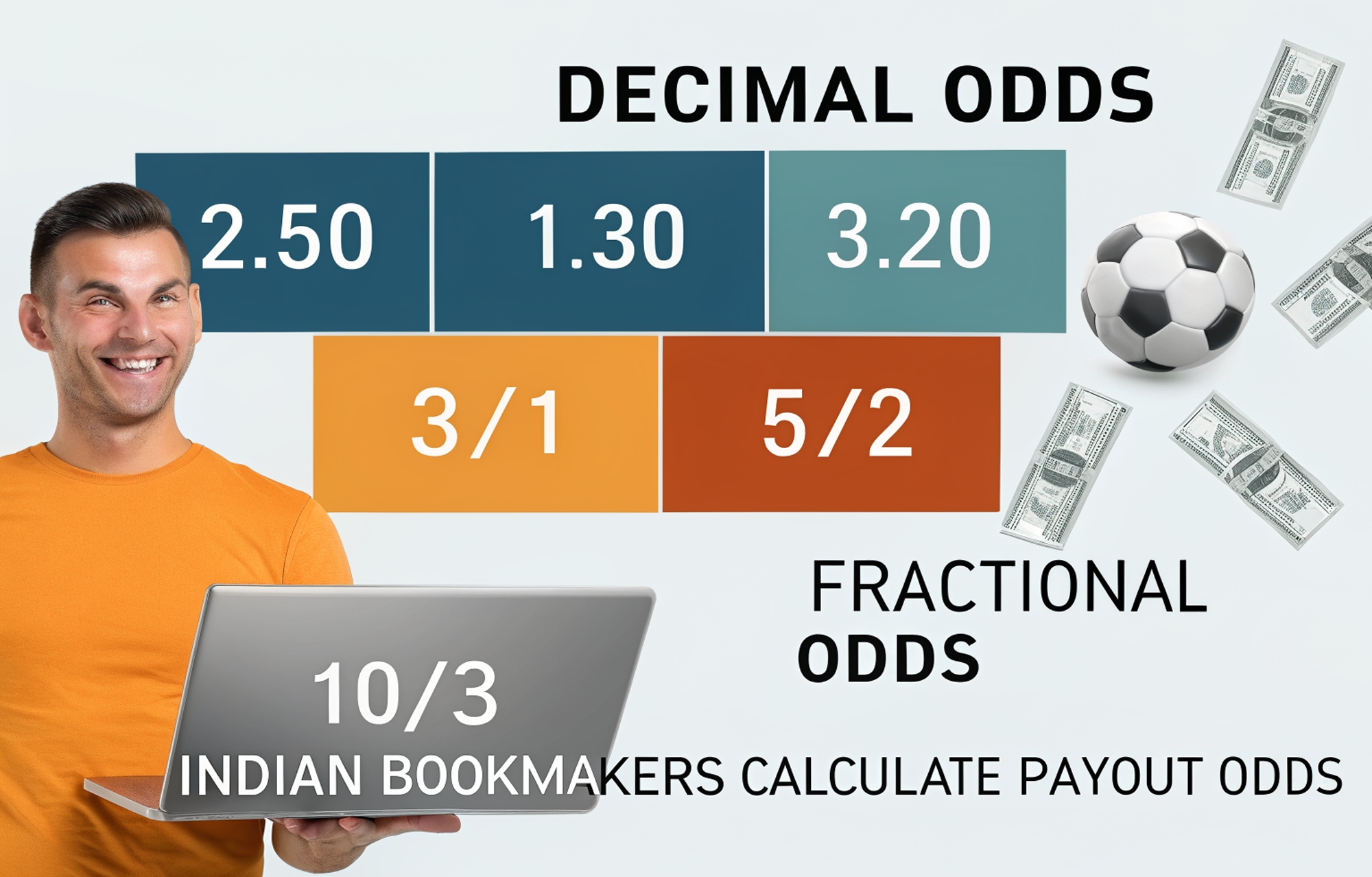
- Displayed as a single decimal number, for example, 2.50, 1.80, or 3.20.
- This number represents the total return on a bet, including your original stake.
- To calculate your payout, simply multiply your bet amount by the decimal number. For instance, a ₹100 bet at 2.50 odds would return ₹250 (₹150 profit + ₹100 stake).
- Very easy to understand and calculate, which makes it the most beginner-friendly format.
- Reflects both the implied probability of an event and the total potential return at once.
- Popular in European markets and quickly gaining traction in India’s expanding betting industry.
- Fractional Odds:
- Traditionally used in the UK and also present in some Indian bookmakers, especially those influenced by British betting culture.
- Written as a fraction or ratio, such as 3/1, 5/2, 10/3, etc.
- The fraction tells you how much you win relative to your stake. For example, 3/1 means you win ₹3 for every ₹1 wagered, plus you get your original stake back.
- To work out the payout, multiply your stake by the numerator and then add the stake. So, a ₹100 bet at 3/1 returns ₹300 profit + ₹100 stake = ₹400 total.
- This format emphasizes the profit part of the bet, not the total payout, which can take some getting used to.
- Often favored by bettors who appreciate a classic, traditional style and those who want to clearly see their profit potential.
- Requires a bit more mental calculation compared to decimal odds but remains widely used in various betting communities.
Why Do Bookmakers Calculate Odds?
| Reason | What It Means | How Bookmakers Achieve It | Impact on Bettors | Challenges for Bookmakers |
| Balance Their Books | Ensuring profit no matter the event outcome | Adjust odds and add margin (vig) to payouts | Odds include built-in bookmaker margin reducing payouts | Predicting betting volume accurately |
| Reflect Real Probabilities | Odds represent actual chances of event happening | Analyze data, stats, and expert insights to estimate probabilities | Bettors get realistic chances to assess risk | Gathering accurate and timely data |
| Attract Bets on Both Sides | Encourage balanced betting on all possible results | Adjust odds dynamically based on betting patterns | More betting options and potentially better odds | Managing risk of heavy betting on one outcome |
| Manage Risk Efficiently | Minimize potential losses from uneven betting | Use odds movement to steer bets and balance liabilities | Limits excessive losses from one-sided betting | Rapid market changes and unexpected events |
| Enhance Market Competitiveness | Stay attractive compared to other bookmakers | Offer competitive odds and promotions | Bettors benefit from better odds and offers | Keeping odds attractive while maintaining profit |
The Math Behind Odds Calculation
Now that you have a solid understanding of what odds represent, it’s time to delve into how bookmakers actually calculate these numbers. The process starts with estimating the true probability of every possible outcome in an event. For example, in a cricket match, bookmakers might analyze data and decide there’s a 45% chance that Team A will win, a 40% chance for Team B, and a 15% chance of a draw. These probabilities don’t come out of thin air — they rely on a rich mix of historical performance, player statistics, pitch and weather conditions, and expert opinions. This careful assessment sets the foundation for the odds that bettors see.
Once these probabilities are established, bookmakers convert them into decimal odds using a simple formula: dividing 100 by the probability percentage. So, if Team A’s winning chance is 45%, the decimal odds would be 100 divided by 45, which equals approximately 2.22. This means that a ₹1 bet on Team A would return ₹2.22 if they win, including your original stake. This conversion translates abstract percentages into a more tangible number that clearly shows potential payout. However, these initial odds represent “true odds” — meaning they reflect the exact probability without considering the bookmaker’s profit margin.
Of course, bookmakers are businesses, and to stay profitable, they add a margin — often called the “vig” or “overround” — to these true odds. This margin ensures that the total implied probabilities across all outcomes add up to more than 100%, giving the bookmaker a built-in advantage. For example, while the true odds for Team A might be 2.22, after adding the margin, the bookmaker might offer slightly lower odds like 2.10. This reduction means bettors receive somewhat smaller payouts than the true probability suggests, but it protects the bookmaker from losing money over time. The margin is a subtle but critical factor that impacts your potential winnings with every bet.
Finally, odds are not fixed and can be adjusted dynamically based on market behavior. If too many bets come in favoring one outcome, bookmakers will tweak the odds to discourage further betting on that side and encourage action on other results. For example, if Team A is getting heavy bets, the bookmaker may lower their odds, making it less attractive to bet on them, while increasing the odds for Team B or a draw to balance the book. This ongoing adjustment helps bookmakers manage risk and ensure they remain profitable regardless of the final outcome. So, behind every decimal number you see, there’s a complex, ever-shifting math process designed to keep the betting market balanced and fair.
Indian Context: How Local Factors Influence Odds
Bookmakers in India operate within a unique landscape shaped by local tastes, cultural preferences, and a complex legal environment. These factors directly affect how odds are calculated, presented, and adjusted. Here’s a detailed list explaining the main local influences that impact the odds-setting process in India:
- Popularity of Cricket:
Cricket is the undisputed favorite sport in India, capturing the attention of millions. Bookmakers prioritize cricket heavily because of the vast amount of available data, player statistics, and fan interest. The large volume of bets placed on cricket allows bookmakers to generate highly precise odds. This abundance of information and betting activity reduces uncertainty, enabling more accurate probability assessments and tighter margins. - Emerging Sports Markets:
Besides cricket, other sports like football, kabaddi, and tennis are gaining traction among Indian bettors. Bookmakers are gradually expanding their offerings to include these sports, adapting their odds-setting strategies accordingly. Since these markets are less mature than cricket, odds for these events may be more volatile or have higher margins due to less betting volume and limited historical data. Bookmakers constantly refine their algorithms to better capture the dynamics of these growing sports markets. - Legal Restrictions and Their Impact:
India’s gambling laws are complex and vary by state, with many forms of betting considered illegal or regulated tightly. As a result, many bookmakers operating in India do so from offshore locations or through legal grey areas. This situation influences several aspects of odds calculation and presentation:- Accessibility: Many betting platforms face challenges in providing seamless access to Indian bettors, which can affect betting volumes and odds competitiveness.
- Market Liquidity: Due to legal constraints, the overall betting market is fragmented, leading to lower liquidity. Less liquidity means less data to inform odds, often resulting in wider margins to protect bookmakers.
- Promotions and Bonuses: To attract and retain players amid legal uncertainties, bookmakers frequently offer special bonuses and promotions, which can indirectly affect odds by shifting betting patterns and volumes.
- Cultural and Regional Preferences:
Indian bettors’ preferences can vary widely based on region, language, and culture. Bookmakers tailor their odds and betting markets to reflect local interests, focusing on popular leagues, tournaments, and players relevant to specific demographics. This cultural customization helps bookmakers engage bettors better and impacts how odds are weighted for particular events. - Technological Adoption and Mobile Betting:
The rapid growth of smartphones and internet access in India has led to a surge in mobile betting. Bookmakers factor in this trend by adjusting odds dynamically in real time, catering to bettors who place wagers on the go. The speed of information flow and immediate bet placement influence how frequently odds are updated in the Indian context.
The Role of Technology in Odds Calculation
| Technology Component | Function | Benefits for Bookmakers | Impact on Bettors | Implementation Challenges |
| Algorithms and Machine Learning | Use AI models to analyze vast datasets and predict probabilities faster and more accurately than humans | Improved accuracy in odds setting, quicker response times, ability to handle complex variables | Bettors receive more precise odds and timely updates | Requires quality data and expert tuning of models |
| Data Feeds and Real-Time Updates | Integration of live stats, weather info, injury reports, and social media trends into odds calculation | Enables dynamic odds adjustment to reflect real-time events and market sentiment | Provides bettors with up-to-date odds reflecting current conditions | Ensuring data reliability and minimizing latency |
| Automated Risk Management | Systems that monitor betting volumes and automatically adjust odds to balance liabilities | Helps reduce bookmaker’s risk exposure by preventing heavy losses on one-sided bets | More balanced markets and potentially fairer odds | Complex to design effective automated rules |
| Cloud Computing and Scalability | Use of cloud platforms to process large volumes of data and support high traffic betting environments | Scalability to handle peak betting periods and massive data inputs | Seamless betting experience with minimal downtime | Cost management and data security concerns |
| Mobile Technology Integration | Apps and mobile-friendly platforms that connect bettors with live odds and enable instant bets | Expands market reach and encourages live, in-play betting | Bettors benefit from convenient, real-time betting access | Maintaining app performance and ensuring fast updates |
Common Terms You Should Know About Odds
If you want to truly understand betting and sound like a seasoned pro, it’s essential to get familiar with some common terms related to odds. These words and phrases are the building blocks of the betting world and will help you grasp how bets work, what your chances really are, and how bookmakers structure their markets. Knowing these terms will also make it easier to analyze odds, compare different bookmakers, and make smarter betting decisions.
First up is the term “odds” itself. Odds serve two main purposes: they express the probability of an event happening and also act as a multiplier for your potential payout. In other words, odds tell you how likely something is to occur and how much money you can win if it does. Whether presented as decimals, fractions, or moneyline numbers, odds are the fundamental numbers you deal with whenever you place a bet. Understanding how to read odds correctly is the first step to knowing what you’re really risking and what rewards you can expect.
Next, the “margin”, sometimes called the vig or overround, is crucial. This is essentially the bookmaker’s built-in profit. Bookmakers don’t offer odds that perfectly reflect the true probability; instead, they tweak the odds so that the sum of the implied probabilities exceeds 100%. This margin ensures that the bookmaker can pay winners while still making money over time. For bettors, this means the odds you see are slightly less favorable than the “true odds,” which is why it’s important to shop around for the best available prices.
Other important terms include “stake” and “payout.” The stake is simply the amount of money you place on a bet. It’s your investment into the wager. The payout, on the other hand, is the total amount you receive if your bet wins, including your original stake plus your winnings. Finally, the term “implied probability” is the chance of an event happening based on the odds given by the bookmaker. It’s a useful way to understand what the odds mean in percentage terms, helping you compare bets and spot value opportunities. Getting comfortable with these terms empowers you to approach betting with greater confidence and clarity.